
kuda.org recommends: COLD PIECE Parameter, Ljubljana
kuda.org announces and recommends the art event in Ljubljana at the end of May 2026 - ADELA Festival of Generative Art, pruduced by Ljudmila
Exhibition Parameter
Cinema Šiška, Ljubljana, May 30, 2026.
Artists: Qianxun Chen, Saskia Freeke, Cyrus Khalatbari, Yann Martins, Milan Milojković & Danilo Šainović, Thomas Pausz, Alevtina Senik, Dorijan Šiško & Aljaž Glaser, jiawen uffline, Julia Vollmer, Vita Eva Weisseisen & Aleksandar Tendjer
As part of the Parametar exhibition, the work COLD PIECE (Hladni mir), 2026, by Milan Milojković & Danilo Šainović, will be shown.
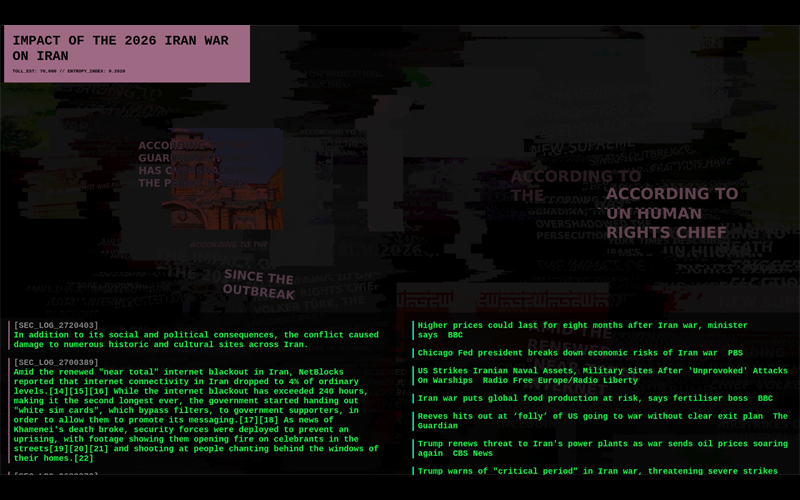
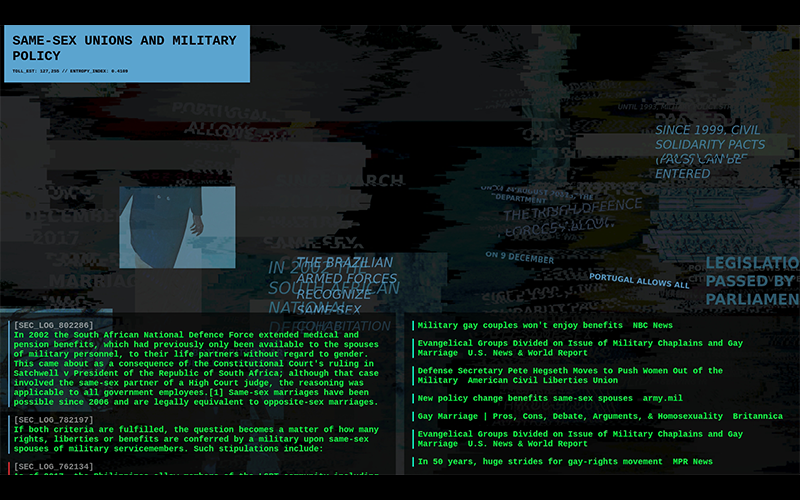
"Cold Peace" is a generative web art installation that at it's core has an automatic algorithm producing audio-visual output. It will automatically generate its output without any user input, from start (run) until it is turned off. It runs on any modern computer with screen and spreakers.On a thematic level it is socially engaged art with an anti-war message. It presents the viewer with the atrocities, absurdity, ideological background and realness of present and past of the war by exposing facts and lies available online about specific and general armed conflicts.One of the goals of "Cold Peace" is to disrupt the viewer's "lulled state" in the idea that war is: (1) something happening somewhere else and to someone else; (2) something that we don't have any control over. In fact, war is happening on our planet, to us as humans, with our money and waged by our ruling class.The video is generated to show: (1) glitching and distorted images and quotes related to the various conflicts - communicating the message on an emotional/aesthetic level; (2) it also generates readable texts (prose) that engages viewers on intellectual level. Those texts explain the conflict from the perspectives from all sides involved. The second part should inspire the viewers to question the one-sided narrative alignment that is often demanded from us, and hopefully see "the bigger picture" of war.The installation operates on a client-server model that bridges live web data with a high-speed generative visual engine. Backend (Python/Flask) acts as the "Intelligence Layer." It utilizes a custom module to scrape and process global news and geopolitical perspectives from RSS feeds. Frontend (JavaScript/p5.js/Leaflet) generates visualization layer. It handles data ingestion, spatial mapping, and the rendering of the generative aesthetic. The core logic of the artwork is driven by a recursive function.The system starts with a Wikipedia entry (e.g., "List of ongoing armed conflicts") and parses the HTML to extract links, images, and casualty statistics. Using a set of "war keywords" (e.g., invasion, insurgency, coup), the system selects a new topic from the current page's links, creating an endless, autonomous journey through present and past human conflicts. The frontend polls the Python backend for curated news headlines and targets that provide a more granular, real-time perspective than the static Wikipedia archives. The visual style reflects the "entropy" of the data being consumed. The installation calculates an archive.entropy value based on the reported death toll of a conflict. As the toll increases colors shift from muted tones to high-contrast reds and vibrants and the glitch frequency increases. Also, visual breaches (horizontal pixel shifts) become more violent. Instead of displaying full images, the program takes random segments of conflict photos, applies rotation, and blends them using varioues modes. Paragraphs from news sources are shattered into fragments and rendered as bold, overlapping graphic elements on the canvas. The background is powered by Leaflet.js, transformed via CSS filters into a high-contrast, inverted "tactical map." When a new conflict node is reached, the system fetches coordinates via the Wikipedia API and "flies" the “camera” to that location. Code then draws "tactical lines" (polylines) between the central conflict node and related geopolitical actors identified in the text, visualizing the web of influence.Audio part consists of streaming coded or voice messages aired on short-wave frequencies from all around the world. By witnessing in real time the cryptic and literal communications within the world of power, viewers can feel the immediateness of what we call "the perpetual and hidden world war". The title "Cold Peace" is satirical comment on the notion that we live in times of peace.
***
Parameter establishes a testing environment for experimental artistic approaches in which technology operates – or fails to do so – differently. It is shaped by formats and practices that, through the revival of obsolete technologies, the conception of as-yet-unrealised protocols and the embrace of error and unpredictability, recode established processes and their traces.Each year, the fair presents a selection of (re)generative creative practices and enables their inclusion in emerging collections. In uncertain ecological, social and political times, Parameter functions as a kind of almanac: a set of artistic proposals for action under present conditions.The fourth edition is marked by a tension between long-term, uncontollable processes and the imprint of individual gestures. Rather than endlessly producing solutions, data and images, the featured works unfold generativity as an effect of operating within constraints. What would happen if our communication were shaped by planetary rhythms? If machine generation required manual materialisation, and computation left directly tangible traces of energy and time? If obsolescence opened the beginning of the next cycle of material and conceptual reconfiguration?
https://wiki.ljudmila.org/Parameter_2026_(en)